
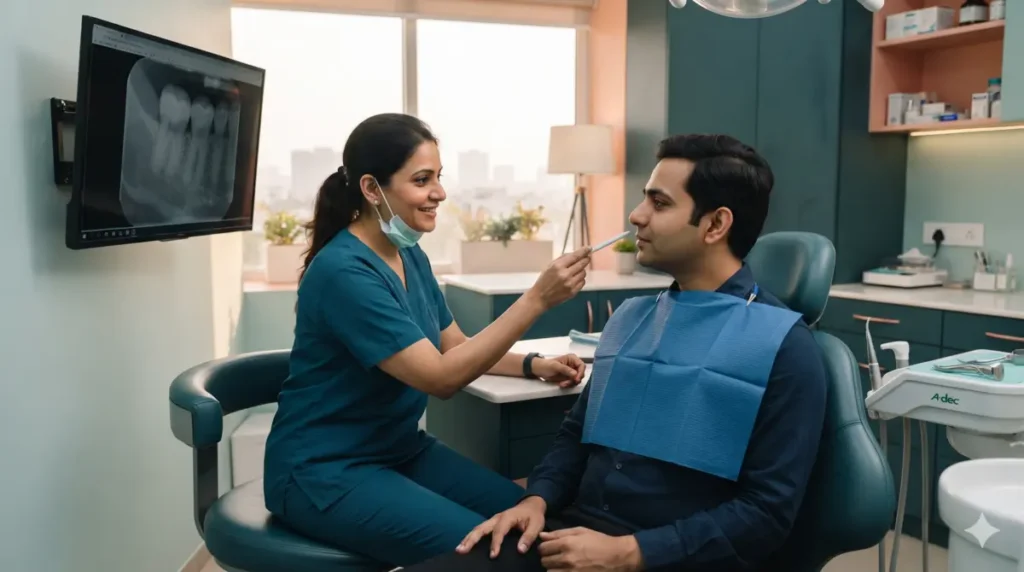
Root Canal Consultation Patient guide · 6-minute read
Understanding a Root Canal Consultation: Questions to Ask
A root canal consultation is a chance to understand what a tooth needs, why treatment is being considered, and what alternatives or follow-up may apply. Use these root canal consultation questions to guide a clear, unhurried conversation.
Hearing that you may need root canal treatment can feel worrying, especially if pain or uncertainty brought you to the dentist. A consultation is not a commitment to proceed. It is a clinical assessment and discussion: your dentist examines the tooth, explains relevant findings, and considers care in context of your health, preferences and priorities. Sai Dental Clinic offers root canal treatment in Gomti Nagar, Lucknow.
Root canal consultation: key points at a glance
Ask what the examination shows
Ask which tooth is involved, what signs support the assessment, and whether an X-ray or other test helps clarify the situation. Request an explanation in everyday language.
Discuss choices
Ask whether root canal treatment, another approach, monitoring, or referral may be relevant—and what each option means for your tooth.
Plan beyond the procedure
Clarify restoration, review, aftercare guidance, warning signs and how to contact the clinic with questions.
Share your context
Medical conditions, medicines, allergies, dental history, anxiety and practical needs can matter to an individualized plan.
What root canal treatment does—and why it may be discussed
Inside each tooth is dental pulp, soft tissue containing nerves and blood vessels. Pulp extends through the crown and into narrow canals in the roots. Deep decay, a crack, trauma or repeated dental procedures can irritate or damage this tissue. When the pulp becomes inflamed or infected, a dentist may discuss root canal treatment, also called endodontic treatment, as one way to clean and seal the inside of the tooth while retaining it.
In broad terms, treatment involves making an opening to reach the canals, removing affected pulp tissue, cleaning and shaping the canal spaces, then filling and sealing them. The tooth usually needs a suitable final restoration to protect it and restore function. The exact approach depends on tooth anatomy, findings, and the clinician’s assessment; this description is not a prediction of what any individual will need.
Symptoms can include lingering sensitivity to hot or cold, pain on biting, spontaneous discomfort, or swelling. Some teeth with pulp problems cause little or no obvious pain. Symptoms alone cannot establish the diagnosis, and pain does not by itself prove that root canal treatment is required. A dentist weighs your history, examination findings and appropriate imaging together.
In Lucknow, searches for root canal treatment often start with a symptom or recommendation. The useful next step is not to assume a specific procedure from a search result; it is to ask the treating dentist to explain the evidence and options for your tooth. Root canal treatment Lucknow patients consider should be based on a personal examination, not general online descriptions.
How a dentist may assess a tooth
Your consultation commonly begins with questions about what you have noticed: when discomfort began, what triggers it, whether it lingers, and whether it has changed. Mention any injury, previous filling or crown, recent dental work, and any swelling or drainage. Tell the dentist what helps or worsens symptoms, without trying to self-diagnose. Bring a list of medicines, allergies and relevant health conditions. Do not stop prescribed medicines unless the clinician who prescribed them advises you to.
The dentist may inspect the tooth, gums and nearby tissues; check existing restorations; and assess the bite or tenderness using appropriate clinical tests. X-rays can help assess decay, root structure and surrounding bone, though they are interpreted alongside the examination. Not every case needs the same tests, and a radiograph may not show every source of discomfort. Ask what each test is intended to clarify and what its limitations are.
Other conditions can resemble pulp-related pain, including a crack, gum problem, referred discomfort or a problem with a neighbouring tooth. Sometimes findings are not conclusive at the first appointment. Your dentist may explain whether further assessment, monitoring, additional imaging or referral is reasonable. A careful discussion of uncertainty is part of good decision-making, not a failure to answer.
Share practical concerns too. If you feel anxious, have difficulty keeping your mouth open, need communication breaks, or have had a difficult dental experience, tell the team. Discuss how you can signal discomfort, what comfort measures are available, and how the team will check in during care. No consultation can guarantee a pain-free experience or a particular result, but questions about comfort deserve a direct response.
Root canal consultation questions to bring
Use this roadmap as a conversation aid. You do not need to ask every question; choose the ones that matter most and ask the dentist to explain unfamiliar terms.
“What did you find?”
Ask which tooth is affected, what the examination and images suggest, and how certain the diagnosis is. Ask what else could explain your symptoms.
“What choices do I have?”
Ask whether root canal treatment is recommended, what alternatives are reasonable, and what may happen if you wait or choose another option.
“What would my care involve?”
Ask about the intended stages, who provides care, what restoration may be needed afterwards, and which findings could change the plan.
“What should I watch for?”
Ask how to get follow-up advice, which symptoms warrant prompt contact, and how the tooth will be restored and reviewed.
Questions about comfort and safety
“What options do you use to manage discomfort?” “What should I tell you if I feel uncomfortable?” “Do my medicines, allergies or health conditions affect planning?” “What risks are relevant to my tooth?” Ask for specific, candid explanations rather than broad assurances.
Questions about restoration and practical details
“Will the tooth need a crown or another restoration?” “How should I care for it while treatment is being completed?” “Who do I contact if I have a concern after the visit?” If fees are discussed, request an itemized estimate and ask which stages or restorations it includes. Avoid relying on generalized costs or timelines.
How treatment choices may differ
The dentist’s recommendation depends on whether the tooth can be predictably restored, the condition of its pulp and surrounding tissues, and your overall circumstances. This comparison is general; it cannot determine which option fits your case.
| Care path | What it may involve | Ask the dentist |
|---|---|---|
| Root canal treatment and restoration | Cleaning and sealing canals, followed by a restoration selected for the tooth. | What evidence supports it? Can the tooth be restored? What follow-up and restoration are anticipated? |
| Another tooth-preserving approach | Depending on diagnosis, another treatment or further assessment may be considered. | What alternatives apply here? What are their limits and how will success or change be reviewed? |
| Extraction and replacement discussion | If a tooth cannot be retained, removal and possible replacement choices may be discussed. | Why is preservation not advised? What are the implications of removal, and what replacement choices exist? |
| Further assessment or referral | More information or input from a clinician with relevant expertise may help clarify a complex case. | What remains uncertain? What would referral or additional assessment help answer? |
Ask the dentist to describe the likely benefits, limitations, risks and consequences of each applicable route. A recommendation should fit your clinical findings and priorities. You can ask for time to consider the information, a written plan, or another professional opinion. If symptoms are worsening, ask the clinic how promptly you should be assessed rather than assuming it is safe to wait.
What to clarify before leaving
Before the appointment ends, make sure you understand the working diagnosis and what remains uncertain. Ask what the next step is and whether it is an examination, a further test, treatment planning or a procedure. Confirm whether the dentist expects to complete treatment in stages or wants to review findings first; do not assume one schedule fits every tooth.
Ask how the tooth will be protected and restored. After canal treatment, the remaining tooth structure and location can affect restoration planning. Your dentist can explain whether a filling, crown or other restoration is being considered and why. The restoration is not a minor afterthought: it is part of the overall plan for function and protection. Ask when it should be arranged and what interim instructions apply to your case.
Request clear written instructions for any care after a procedure, including whom to contact with concerns. Ask which changes should prompt a call and what to do if you cannot reach the clinic. If a tooth has temporary material or treatment is incomplete, confirm how and when follow-up will occur. Do not rely on a generic online timeline or instructions meant for another person.
If you are uncertain about a recommendation, say so. You might ask the dentist to draw or show the relevant finding, summarize the options, or explain the reasoning again. A second opinion can be reasonable when you need more clarity, particularly before irreversible treatment. Bring existing records or images when possible, and ask the clinic how to obtain copies. Decisions should be informed and voluntary.
Finding reliable root canal guidance in Lucknow
Choose follow-up guidance from a qualified dental professional who can examine you and review relevant records. Online articles can explain terminology, but cannot determine whether a particular tooth needs treatment. For root canal treatment in Lucknow, Sai Dental Clinic offers this service in Gomti Nagar. Review the clinic’s Services page for service information, or use the Contact page to ask about arranging an appointment. Confirm current appointment details directly with the clinic.
Bring your questions, medical information and any relevant dental records. Tell the dentist what outcome matters to you, what worries you, and what you did not understand. A careful consultation helps you make sense of the diagnosis and decide on next steps with your clinician.
Frequently asked questions
Does consultation mean I must start root canal treatment?
No. A consultation helps clarify findings and choices; it does not itself require you to consent to treatment. Ask for a written plan and time to consider it. If symptoms are changing, ask the dentist about appropriate timing for reassessment.
What should I bring to a root canal consultation?
Bring a list of medicines and allergies, relevant health information, details of previous dental work, and any recent dental images or reports you have. Write down your symptoms and questions so you can cover what matters to you.
Can symptoms alone show whether I need a root canal?
No. Symptoms can guide assessment, but different dental problems may feel similar, and some pulp problems cause few symptoms. Diagnosis depends on the dentist’s history-taking, examination and appropriate tests or imaging.
Can I ask for another opinion?
Yes. You may ask for clarification, time to decide or another qualified professional’s opinion. Request relevant records or images and ask how promptly you should follow up if symptoms are worsening.
Prepare for a clear, patient-first conversation
Understand your tooth’s findings, options and follow-up before making a decision. Sai Dental Clinic offers root canal treatment in Gomti Nagar, Lucknow.